
at Vande Mataram came to mean
The Vande Mataram we know today isn’t necessarily the Vande Mataram that was originally sung.
That was one of the first things that struck me while preparing for Friday’s programme at Saraswathi Vidyanikethan, Elamakkara.
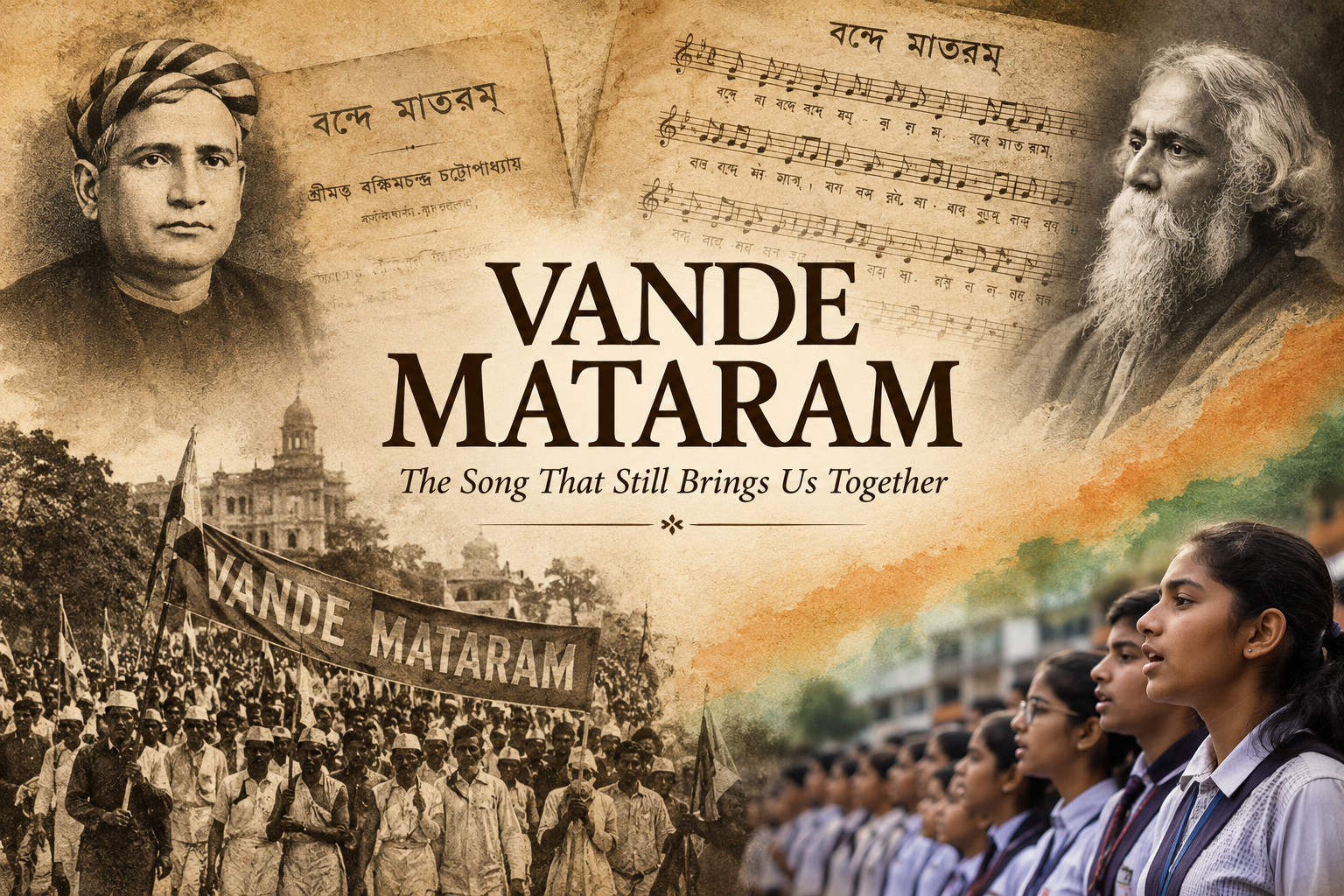
Most of us know the familiar tune almost instinctively. We know the words Vande Mataram. We know that it is India’s National Song. But its musical history is much older and more complicated than the version most of us hear today. The song, written by Bankim Chandra Chattopadhyay in the nineteenth century, was set to different compositions over time, including an early composition associated with Jadunath Bhattacharya and Rabindranath Tagore’s well-known rendition at the 1896 Indian National Congress session.
And somehow, around 150 years after the song was written, we were standing in a school ground preparing to sing it again.
Not just us.
Across India, thousands of locations were preparing to do the same thing.
On September 25, 2026, a nationwide programme attempted to bring together an enormous number of people for a simultaneous rendition of Vande Mataram, with participation reported from more than 25,000 locations. SVN Elamakkara was one of them.
What surprised me most about the entire thing was not really the record attempt.
It was the fact that a song could still do this.
A song.
Not even the National Anthem.
The National Song.
A composition from an India that existed before independence, before the Constitution and before the Republic itself was capable, decades after independence, of bringing together millions of people simply to sing it at the same time.
That is something I had never really stopped to think about before.
At SVN, it wasn’t something that happened overnight
The few minutes during which everyone actually sang were probably the smallest part of the preparation.
The programme had been planned for weeks.
Students had to become familiar with the tune of the song, rehearsals had to be conducted after assemblies, arrangements had to be made, and teachers and students had to coordinate the countless details that are easy to overlook when looking at the final event.
We had already been singing Vande Mataram during morning assemblies — not once, but repeatedly — so that the entire student body would be familiar with it by the time the actual programme arrived.
Even the musical rendition had been given particular attention.
Rather than simply using the modern tune most of us recognise, the school deliberately worked with an older rendition, attempting to reconnect the performance with the song’s earlier musical history.
That detail stayed with me.
If the purpose was simply to participate in a record attempt, there would have been little reason to put that much thought into how the song was sung.
Instead, there seemed to be an emphasis on making students actually know what they were singing.
And that became clearer during the programme itself.
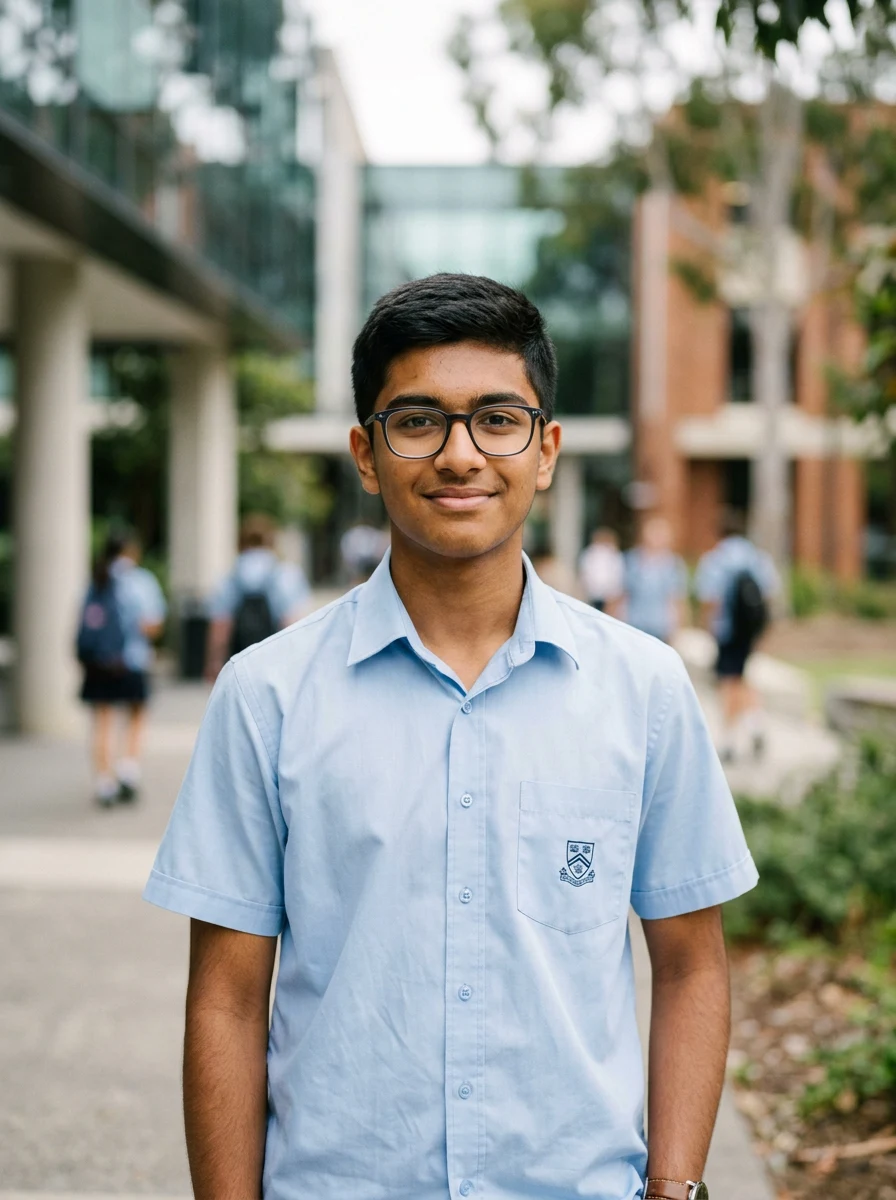
On Friday, students, teachers, staff and parents gathered at the school. The programme was inaugurated by Prof. D. Mavooth, Vice-Chancellor of Mahatma Gandhi University, who served as the chief guest. Also present were P. Kuttikrishnan, President of the Rashtra Dharma Parishad, and Lakshmi Narayanan, its Secretary, along with our Principal, K. P. Dinto, Vice Principal Deepa K. Nair, Headmistress Sandhya Sreekumar and School Manager K. V. Manoj Babu. Our Head Boy, Ishaan Nair, and Head Girl, R. Vaiga, were also part of the programme.
Around 2,000 students, teachers, staff and parents participated at the school.
And then came the actual rendition.
A few minutes.
That’s all it took.
But those few minutes represented weeks of preparation at our school — and similar preparation at countless other locations across the country.
That contrast is what makes the scale of the event so striking.
Something that lasts only a few minutes can require weeks of thought, organisation and rehearsal.
And then, at the appointed time, those few minutes become part of something happening simultaneously across an entire country.
The numbers are difficult to picture from inside one school.
Standing among thousands of students at SVN, it is easy to think of the people around you as the event.
But then there are thousands of other schools, institutions and public gatherings doing the same thing.
Different states.
Different languages.
Different communities.
Different traditions.
Different cultures.
And yet, for those few minutes, they were all singing the same song.
The reported participation was approaching a crore of people — a number so large that it is almost easier to understand by comparison. That is roughly the population of an entire small country.
All of them connected, temporarily, by a song written around a century and a half ago.
And that is where I think the present controversy around Vande Mataram becomes particularly interesting.
What exactly are we arguing about?
Vande Mataram has become controversial in modern India for several reasons, particularly because some of its later verses use imagery rooted in Hindu religious traditions.
That is a genuine part of the history of the song, and it should not simply be ignored.
But I think there is an important distinction that sometimes gets lost.
Singing Vande Mataram is not, by itself, an attempt to promote one religion.
Nor does participating in a rendition require someone to belong to that religion.
And, importantly, recognising the historical significance of Vande Mataram does not require believing that anyone should be forced to sing it.
Those are separate questions.
What SVN was doing was not asking students to adopt a religion.
It was trying to make students familiar with a historical symbol.
And that distinction matters because Vande Mataram’s history is considerably broader than any one modern political or religious interpretation of it.
A symbol carried by people who were not all the same
The freedom struggle was not fought by one homogeneous group of Indians.
People who participated in it came from different religions, languages, regions, communities, cultures and traditions.
And Vande Mataram became one of the symbols through which that movement expressed itself.
The song’s political significance grew considerably during the anti-Partition and Swadeshi movements of the early twentieth century. Accounts of the period describe students representing different communities marching while shouting Vande Mataram. The song had also already been performed at the 1896 Indian National Congress session, where Rabindranath Tagore sang it under the presidency of Rahimtullah M. Sayani, a Muslim from Bombay.
That history is worth remembering.
Because it complicates the idea that Vande Mataram can only be understood through the religious imagery present in parts of its lyrics.
The imagery exists.
The debate surrounding it exists.
But so does the history of the song being used by people from different backgrounds in a common political struggle against British rule.
Those things can be true at the same time.
And that is perhaps why I find it difficult to see Vande Mataram simply as a symbol belonging to one religion.
It wasn’t created by modern political movements.
It wasn’t born in today’s political environment.
Its history stretches back to colonial India, and its meaning developed through the people who adopted it during the struggle for independence.
Why preserve it after independence?
India could have simply moved on after 1947.
The country had a new government, a new Constitution and eventually a National Anthem.
But Vande Mataram was not discarded.
On January 24, 1950, when the Constituent Assembly formally dealt with the question of the National Anthem, Dr. Rajendra Prasad stated that Vande Mataram, because of its historic role in the freedom struggle, would be honoured equally with Jana Gana Mana and would have equal status with it.
That distinction is important.
Vande Mataram did not become the National Anthem.
Jana Gana Mana did.
But the Constituent Assembly still deliberately recognised the extraordinary historical importance of Vande Mataram.
The reason was not simply that it was an old song.
It was what the song had come to represent.
It had been part of the cultural and political language of the independence movement.
It had helped inspire people during the struggle against colonial rule.
It had become something larger than the circumstances in which it was originally written.
And perhaps that is what SVN was trying to communicate to its students.
Not that everyone must interpret every line identically.
Not that singing it makes someone part of a particular religion.
Not that anybody has to be compelled to participate.
Simply that if a song played such a significant role in the history of the country, the generation inheriting that history should at least know it.
Not just the two lines everyone recognises.
The whole song.
Its history.
Its evolution.
Its place in the freedom struggle.
And the reasons why it remains nationally significant.
Remembering a symbol without rewriting it
There is a temptation, whenever something becomes controversial, to reduce it to whichever part of the controversy is most convenient.
With Vande Mataram, that can mean focusing entirely on its religious imagery.
But doing so risks overlooking the rest of its history.
At the same time, pretending that the religious imagery does not exist would be equally incomplete.
The better approach is to acknowledge both.
Yes, parts of the song draw upon imagery from a particular religious and cultural tradition.
Yes, that has generated legitimate debate, especially in a country as religiously and culturally diverse as India.
But Vande Mataram also became a rallying cry in a freedom movement involving people of different religions, communities, languages and regions.
Those people did not all become identical by singing it.
They were still different.
They simply found something they could rally around.
And that is a history worth acknowledging rather than replacing with a modern interpretation.
The point of the programme at SVN, at least as I understood it, was not to turn Vande Mataram into a religious declaration.
It was to preserve a historical memory.
To remind students that the freedom struggle had its own songs, symbols and stories, and that these things were carried forward because they meant something to the people who lived through that period.
And then, for a few minutes, we sang
After weeks of preparation, the actual moment passed surprisingly quickly.
Students stood together.
Teachers stood with us.
The guests and organisers were there.
Thousands of voices came together.
And then it was over.
But somewhere else, thousands of other groups had just finished doing the same thing.
That is the part I keep coming back to.
A song written roughly 150 years ago.
A song that isn’t even India’s National Anthem.
A song whose musical history has changed across generations.
A song that has been debated, criticised, interpreted and sometimes reduced to only its opening lines.
And yet, decades after independence, it can still bring millions of people together for a few minutes.
Perhaps that is why Vande Mataram deserves something more than either blind celebration or outright dismissal.
It deserves to be understood.
Not as the property of one religion.
Not as the property of one political organisation.
Not as something that every Indian must be forced to sing.
But as a historical symbol that was carried by people from an extraordinary variety of backgrounds during the struggle to free this country.
The people who sang it then were not all the same.
The people who sang it on Friday were not all the same either.
And perhaps that is the most interesting thing about the whole event.
For a few minutes, all those differences were still there — but so was the song.
Vande Mataram.