

Some books introduce you to a world.
Some books make you want to live in it.
And then there are books that make you come back years—or even just a reread—later and realise that the world you thought you understood was hiding a lot more underneath.
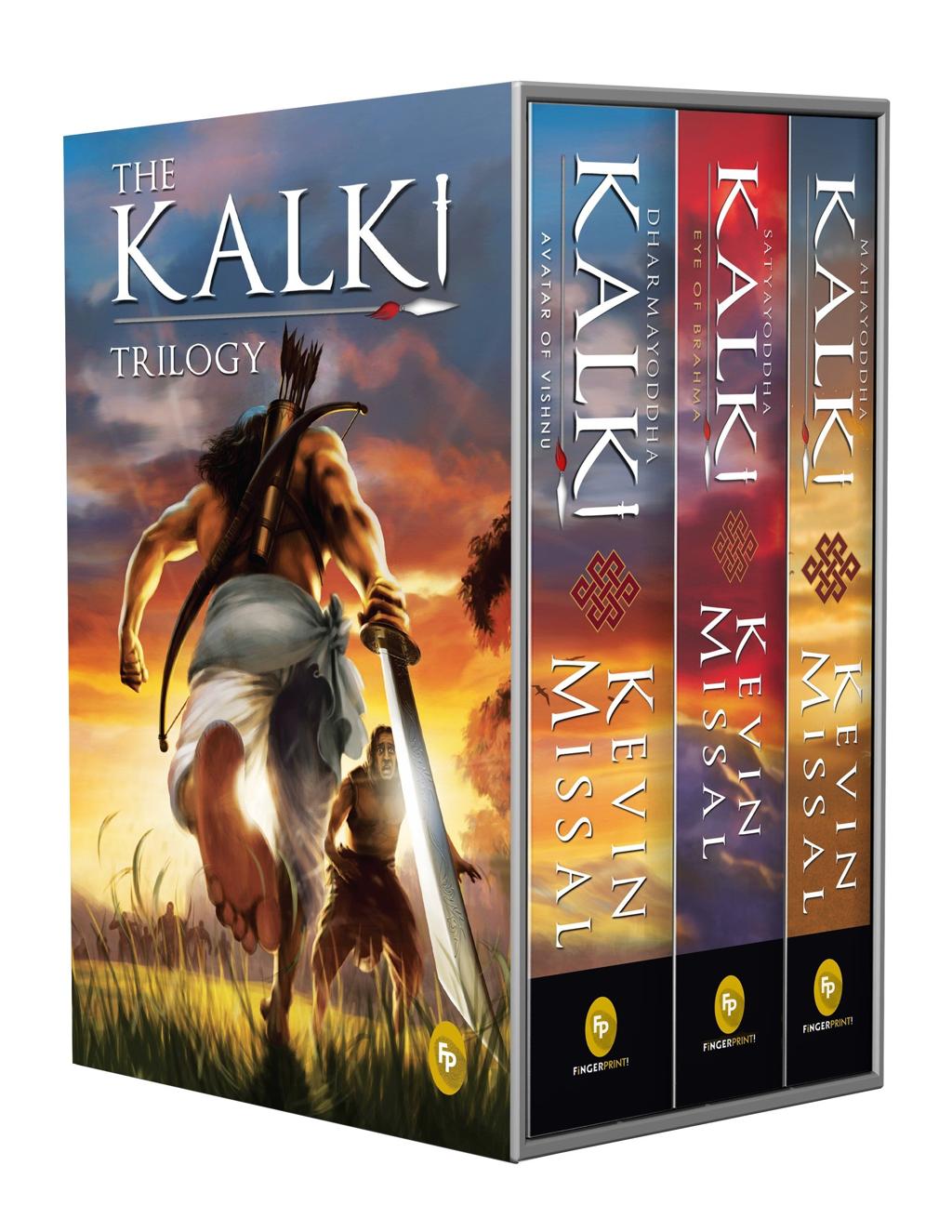
For me, Kevin Missal’s Kalki Trilogy was that kind of book.
The first time I read it, I didn’t think too much about what it was trying to say. I was too busy enjoying it.
Gods, warriors, powers, prophecies, kingdoms, battles, mythical creatures and a protagonist who was supposed to become the tenth avatar of Vishnu. Honestly, it felt like discovering an Indian superhero story that had somehow been waiting for me all along.
And I was absolutely hooked.
The trilogy begins with Dharmayoddha Kalki: Avatar of Vishnu, where we meet Kalki as a rather ordinary, somewhat reckless young man from Shambala. Except, of course, he isn’t exactly ordinary. As the story unfolds, Kalki discovers more about his identity, his abilities and the prophecy surrounding him, eventually becoming involved in a much larger conflict between forces of Dharma and Adharma.
The story then expands through Satyayoddha Kalki: Eye of Brahma and Mahayoddha Kalki: Sword of Shiva, taking Kalki far beyond the village where his journey began and into a world of gods, kingdoms, Nagas, Yakshas, Asuras, immortals, political struggles and ancient powers.
And that scale is one of the first things I loved about the trilogy.
Indian mythology has always had stories that feel almost impossible in their scale. Gods, demons, enormous battles, divine weapons and people who seem to carry the weight of entire worlds on their shoulders. Missal takes that feeling and turns it into a fantasy adventure that feels surprisingly cinematic.
There is even a magic system called Channeling, legendary weapons like the Sword of Shiva, and a whole world called Illavarti inhabited by different races and peoples. The trilogy doesn’t simply take familiar mythological names and place them into a story. It builds its own fantasy world around them, mixing mythology with entirely fictional elements.
The first time I read it, this was what grabbed me.
It felt cool.
But then I read it again.
And this time, I started noticing the people underneath all the mythology.
Kalki’s journey is not simply about becoming stronger.
It is about becoming worthy of the identity everyone expects him to carry.
One of the most interesting ideas in the trilogy is that being an avatar isn’t simply about being born special. Kalki has to make choices and earn the person he is supposed to become. He begins as a boy who needs training and guidance, and gradually grows into someone capable of carrying responsibility far beyond himself.
And despite all the prophecy surrounding him, Kalki doesn’t suddenly stop being human.
He gets scared.
He doubts himself.
He needs mentors.
He makes mistakes.
He struggles with expectations.
At one point, when comparing himself to Bajrang, he admits, “I can never be like you.”
That line means something very different when you look at the story as more than a fantasy adventure.
Because most of us will never be told that we are destined to become the avatar of a god.
But we do know what it feels like to look at someone else and think, I’ll never be like them.
We know what it feels like to have expectations placed upon us before we are even sure what we want for ourselves.
And perhaps that is what makes Kalki’s journey surprisingly relatable.
He isn’t interesting because he is perfect.
He is interesting because he isn’t.
The same idea extends to the people around him.
Arjan, Kalki’s brother, is one of the characters who became much more interesting to me on a second reading. He isn’t simply there as another important figure in the story. He acts almost as Kalki’s conscience, while his own journey takes him into some very dark places before ultimately leading him to sacrifice himself to save the world.
And that creates one of the trilogy’s most interesting ideas:
Dharma and Adharma aren’t always as simple as we want them to be.
A person associated with Adharma can still make a heroic choice.
A person who claims to stand for Dharma can still be cruel.
The immortals who are supposed to represent righteousness aren’t always morally perfect, while characters such as the Nagas have grievances and histories that make their actions more complicated than simply calling them villains.
Even Kali, the main antagonist, becomes more interesting when you stop looking at him simply as the bad guy. His actions are tied to survival, fear and the history of his people. That doesn’t erase what he does, but it gives the character another dimension.
And that was something I missed the first time.
The first time, I wanted to know who was good and who was bad.
The second time, I started wondering why they became that way in the first place.
That is probably one of my favourite things about the trilogy.
It doesn’t always give you comfortable answers.
There is also a lot of love, friendship and companionship woven through the story. Characters like Laxmi and Padma aren’t simply there to fill space around Kalki; they provide emotional and tactical support as his journey becomes increasingly difficult. The larger group also develops into something resembling a band of very different people working toward a common goal.
And honestly, that’s something I enjoy in almost any story.
You can have the most powerful protagonist imaginable, but watching a group of completely different people learn to rely on each other is often far more satisfying.
Of course, the trilogy isn’t perfect.
This was something I noticed much more clearly the second time around.
There are a lot of characters.
And I mean a lot.
Sometimes new characters, places, factions and ideas are introduced so quickly that I found myself having to stop and remember who everyone was. The second book in particular has been noted for slowing down because of its larger cast and parallel storylines, while the trilogy’s various subplots add to the information density.
The pacing can also be uneven.
The books are generally fast and cinematic, which is part of what makes them so easy to get caught up in. But that same speed can occasionally work against the story. The conclusion of the third book, for example, has been criticised for resolving major events very quickly, while some earlier sections can feel as though they take longer than necessary.
And then there are moments where I just wanted the story to slow down.
Give the characters another chapter.
Let that conversation breathe.
Let that loss actually sink in.
Because when a story is constantly moving towards the next battle, sometimes the moments between the battles are the ones that deserve more attention.
Still, these flaws never stopped me from enjoying the trilogy.
If anything, they are almost the consequence of one of its greatest strengths: there is always something happening.
The writing itself contributes to that feeling. It is generally accessible and easy to follow, while the action has a very cinematic quality. The author has spoken about wanting the story to be visually enriching, and that ambition is definitely noticeable in the way the world and its battles are presented.
And perhaps that explains why my first experience with the trilogy was so different from my second.
The first time, I saw the spectacle.
The second time, I saw the struggle.
I saw a boy who was supposed to become a god but still had to deal with fear.
I saw people fighting not only enemies, but their own ideas of loyalty and righteousness.
I saw that someone could be born into a particular role without necessarily being worthy of it.
And I saw that sometimes the difference between Dharma and Adharma isn’t a magical line dividing two sides.
Sometimes it is a choice.
Sometimes it is a decision made when nobody is watching.
And sometimes, two people from the same family can stand on completely different sides of that line.
That is what made the Kalki Trilogy more than just an exciting fantasy series for me.
The first time I read it, it felt like I had discovered an Indian superhero.
The second time, I realised I had been reading about something much more human:
a person trying to become the person everyone else already believes he is.
And maybe that’s why I still love these books despite their flaws.
Because the first time they made me want to know what happens next.
The second time, they made me stop and ask why it happened.
And whenever a book can make you do both, I think it has already done something pretty special.